
Why People Are Leaving Metro Chaos for Dehradun — And Not Looking Back
14 Jan 2026
8 min read
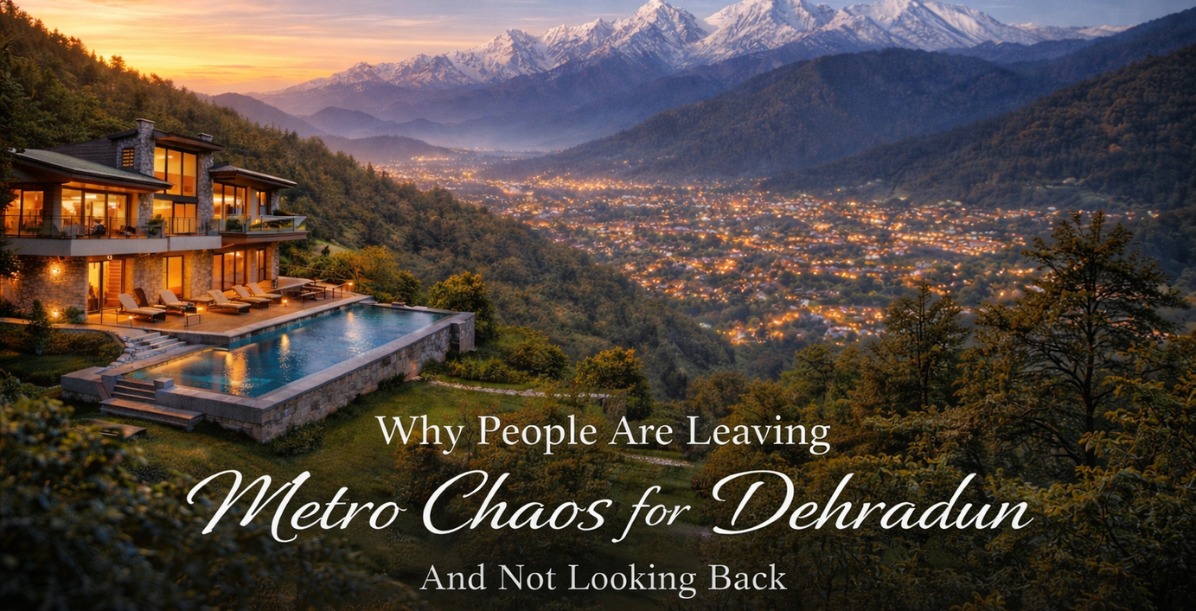
Table of content:
Megacities in India are still providing magnitude and opportunity, but they are also accompanied by the congestion, longer traveling hours, and stress levels rising up day by day. This disproportion has become so acute among several professionals and families whereby the quality of lifestyle is considered more important than the closeness to corporate centers. Dehradun has taken the shape of a good alternative, as it provides a working urban lifestyle without the pressures that characterize the metro lifestyle.
The shift is not impulsive. Individuals relocate based on critical consideration of daily activities, health outcomes, and sustainability.
Majority of personal time is required to cover simple tasks in the metro cities. Travel time, congested transport means, and environmental stress decrease efficiency. Even more money cannot recompense the daily tiredness almost all residents feel.
The factors that may act as major constraints concerning relocation are
Too much time commuting and the work-life balance.
Constant air and noise pollution.
Expensive living and low adaptability of lifestyle.
Less family, rest, and personal health time.
These are the reasons that make individuals think about those cities that promote stability and not continuous adaptation.
Dehradun has offered me a place where life processes with limited disturbances daily. Critical amenities accessible in the city are not too dense. The inhabitants of the regions are able to organize their schedules without considering the unexpected delays.
The city promotes an organized lifestyle. The roads are not congested during the peak time, the amount of noise in residential areas is lower, and the necessary services reach the whole city. This building enables individuals to have more control over work and personal life.
Remote and hybrid working has also minimized the necessity to be near traditional business areas. Reliable connectivity, peaceful environment, and stable infrastructure have become the priority concerns of professionals.
Dehradun is well-equipped for such requirements:
Constant internet connectivity in residential zones.
Scheduling friendly working conditions with reduced interruptions.
Increasing supply of co-working and service space.
Fewer operation requirements than the metros.
This has changed the movement to be viable and sustainable.
Families are growing more discerning about cities with regard to long-term appropriateness than short-term convenience. Metro life usually makes travelling to school, healthcare, and everyday schedules difficult. The framework provided in Dehradun is more manageable.
The residential places combine schools, hospitals, and open spaces more uniformly. Children do not have to commute as much and families are able to have routine schedules. Such practical benefits have a powerful effect on the relocation choices.
In Dehradun, there is no focus on density in housing. Residential projects provide more space planning and reduce congestion in the neighborhoods.
The major residential features are:
Reduced population density in residential areas.
Improved natural light and ventilation in houses.
Less noise than the metro housing clusters.
Long-term dwelling layouts.
This will make the residents feel more comfortable when leaving compact metro accommodation.
Most of the individuals start by transferring to Dehradun, not permanently. In the long run, the positive aspects of regulated living support the decision. Coming back to metro cities does not always seem to be necessary after citizens get used to regular schedules and less stress.
A lack of an urgent need on a daily basis becomes obvious. Inhabitants save time and energy without working out professional continuity.
In Dehradun, real estate decisions are mainly usage-based. Customers are concerned with the livability, suitability of the location, and comfort in the long run. The speculative demand is low because of the development restraints and land restrictions.
This will provide a stable property sector where prices will be based on actual demand and not fast cycles.
Dehradun suits individuals and families seeking structured living, predictable routines, and health-oriented environments. It works well for professionals with location flexibility and those planning permanent settlement. However, it may not suit people who depend on high-density urban networks or thrive in fast-paced social and commercial ecosystems.
The movement away from metro cities reflects a conscious lifestyle correction. Dehradun offers a city model that values balance, control, and long-term comfort. For those prioritizing sustainable living, leaving metro chaos is not a compromise—it is a considered decision.

.png)
Puravankara Enters Greater Noida: What Its ₹340 Crore Land Deal Means for NCR Real Estate.
.png)
How Millennials Are Changing the Indian Real Estate Market.
.png)
Max Estates Enters Ghaziabad with a ₹2,500–3,000 Crore Residential Project.

What Is a Penthouse? Advantages and Disadvantages of Buying a Penthouse in India.
.png)
.png)
