Greater Ghaziabad in 2027: What the Proposed Municipal Merger Means for NCR Real Estate
25 Feb 2026
11 min read
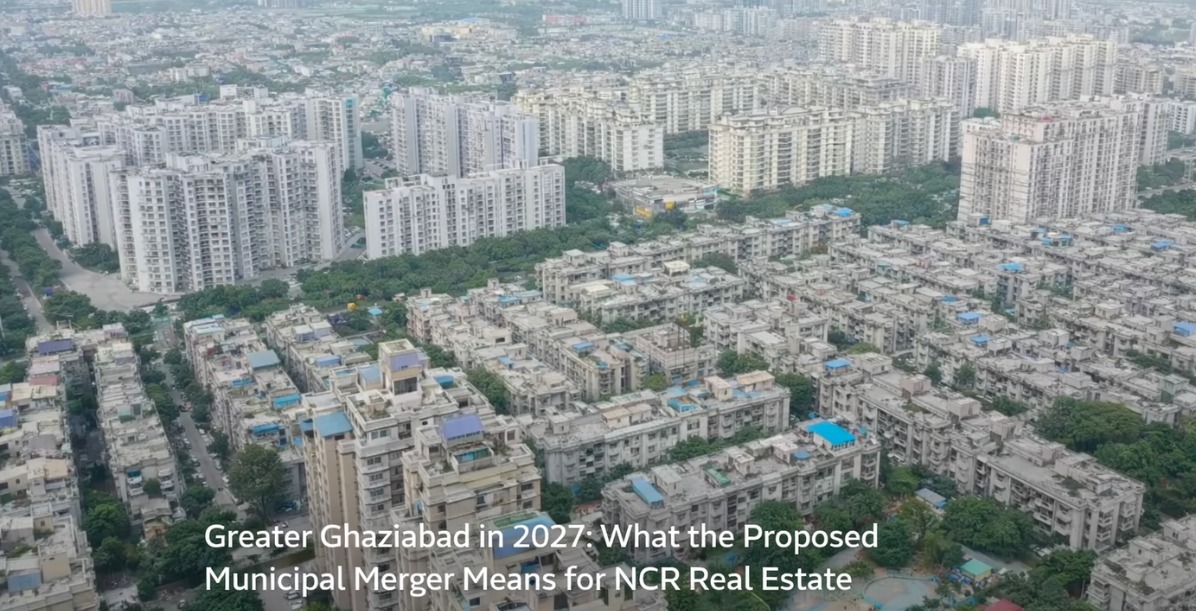
Table of content:
According to recent reports, the merger of the three urban local bodies into the Ghaziabad Municipal Corporation in 2027 could make Greater Ghaziabad become a reality. In case it is adopted, this would make the municipality of Uttar Pradesh the biggest in terms of wards.
This is not administrative news to the residents, buyers, investors, and developers within the Ghaziabad-Noida Belt in East Delhi. The boundaries of cities have an immediate effect on the funding of infrastructure, service provision, taxation structures, and urban designs. In the long run, these drive the livability and the perception of the real estate market.
This article describes what will be proposed, how the plan has developed, what it may entail on the market, and what will interest stakeholders to watch in the future.
According to the latest news, the government is planning to combine three Nagar Palikas into Ghaziabad Municipal Corporation.
Areas Proposed for Merger
Loni Nagar Palika
Khoda-Makanpur Nagar Palika
Muradnagar Nagar Palika
Should it be passed, the increased municipal corporation can be subject to significant structural alterations. The gross area might rise to a large extent, the population base might expand to above 25 lakh, and the wards might rise more than twice.
The expansion is reported to render Ghaziabad the highest wards municipality in Uttar Pradesh and overtake cities such as Kanpur and Lucknow.
It is necessary to mention that it is a proposal. No legal merger has transpired until formal notifications are made.
The plan of developing Ghaziabad into a bigger municipal area has been changing with time in the last two years.
Key Milestones
June 2025: The proposal was publicly talked about on a senior level visit of the government to Ghaziabad.
Mid-2025: The local government of the district started working on an expansion roadmap.
2025-26: It is said that the state council of ministers reviewed the proposal.
2026: It was slackening progress because of elections and census-related processes.
2027 (estimated): This was one of the dates given by the people in charge as to when it may be implemented.
The status quo implies that the framework is still in development. The merger is still in progress without any official announcement and finishing of the wards.
Restructuring of the municipalities influences the processes of the city operation and development. In the case of real estate the governance quality and service delivery are important in long term value creation.
1. Increased Financial Adequacy and Civic Expenditures
As the population and wards grow, municipal authorities tend to get more grants at the state and central levels. This also enhances revenue collection because of a bigger tax base.
This may result in the improved funding of roads, drainage, lighting and waste management. Nevertheless, the larger administration does not necessarily imply improved governance. The quality of execution is based on planning, staffing, and accountability.
2. Better Planning and Regional Co-ordination
Being a part of a populated city of Delhi-NCR, Ghaziabad functions in a thick urban belt. A single municipal government can assist in the enhancement of transport, utility and enforcement coordination.
Improved coordination in the next zone also lessens the service breaks and administrative strife, which is an advantage to residential and business growth.
3. Cumbersome Maintenance and handover difficulties
Previous reports indicate that the transfer of handovers and infrastructure between the development authorities and the municipal bodies is normally characterized by delays.
A greater municipal area confers on it a larger scale:
Colony handovers.
Operation and maintenance roles.
Utility integration.
Management of road and drainage.
will increase. Unless handled carefully, these transitions may have an impact on the quality of services.
In the case of the merger, alterations will not be manifested immediately. The civic change is often gradual.
Possible Long-Term Benefits
Greater complaint redressal system unity.
Regional uniformity on service delivery.
More infrastructure spending should be prioritised.
Better financial profile of the municipalities.
Potential Transition Challenges
Changes in ward boundaries
New service contracts and suppliers.
Interim confusion of jurisdiction.
Modification in the approval procedures.
The residents are supposed to experience a transition period prior to the improvement of stability.
Such a development should be understood by various stakeholders in terms of their long-term goals.
For End-Use Buyers
The homebuyers are expected to observe actual service performance within their locality such as drainage, water, waste collection, and road maintenance among others. The reforms in governance are also important provided they lead to improvements at the ground level.
For Property Investors
This is a development indicator of governance and not a price signal. Sustainable value is pegged on employment development, accessibility, maturity of the infrastructure, and discipline on supplies.
This should be a long-run structural effect of investors, rather than a market catalyst in the short run.
For Developers and Resident Associations
Administrative transitions are the time when documentation and compliance are more crucial. To prevent future arguments, developers and RWAs should ensure that they are clear with handover records, completion certificates, and preservation of maintenance responsibilities.
Stakeholders must keep up to date with the official events instead of depending on rumours to keep them updated.
Practical Checklist
Notifications on approval of mergers by the government.
Updates on boundary and ward delimitation.
Announcements concerning elections and census.
Budgetary appointments to the new corporation.
Administrative restructuring plans and staffing plans.
The reforms in billing and property tax.
Coordination consults with authorities of development.
These indicators will show the quality and seriousness in which the proposal is being executed.
The proposed Greater Ghaziabad merger is symptomatic of the desire to modernise the city governance in a fast growing NCR. When effectively carried out, it can enhance financial capability, planning integration and service provision.
Nevertheless, the increase in the size of the city is not an assurance of a higher quality of life. The winning part will be based on efficiency in administration, transparency, and long-term investment in the development of infrastructure.
At the moment, it is just a policy-in-progress. It should be viewed by its stakeholders as a governance trend to follow rather than a market-altering event.

.png)
Puravankara Enters Greater Noida: What Its ₹340 Crore Land Deal Means for NCR Real Estate.
.png)
How Millennials Are Changing the Indian Real Estate Market.
.png)
Max Estates Enters Ghaziabad with a ₹2,500–3,000 Crore Residential Project.

What Is a Penthouse? Advantages and Disadvantages of Buying a Penthouse in India.

.png)
.png)