
What Is a Penthouse? Advantages and Disadvantages of Buying a Penthouse in India
29 Sep 2026
13 min read
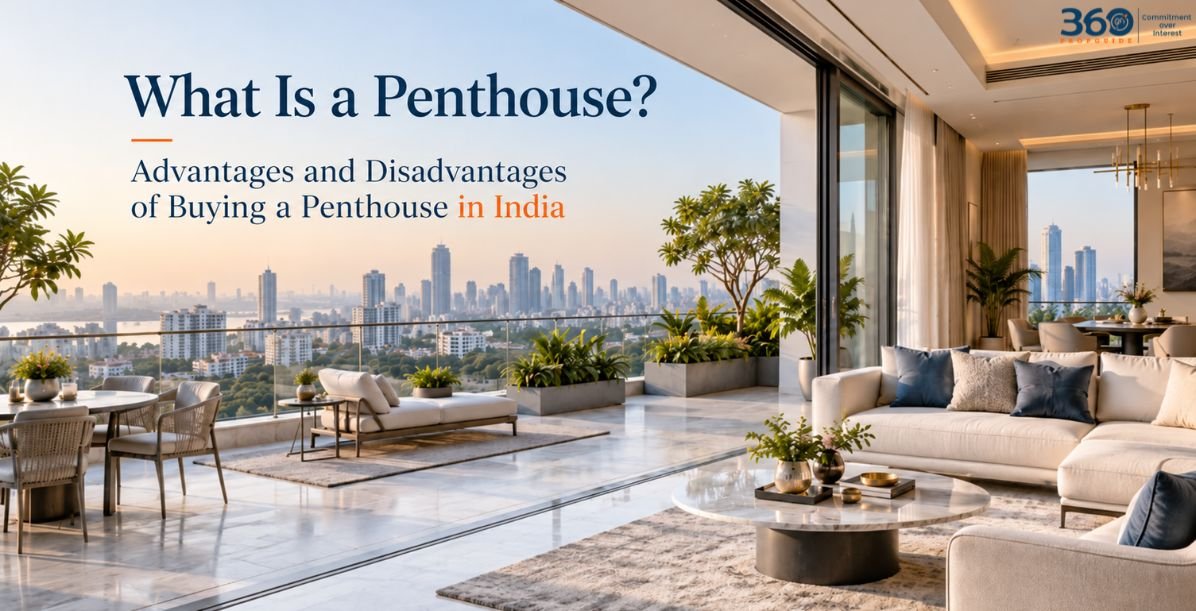
Table of content:
When a penthouse is mentioned, a grand design, top-end amenities, privacy and a large view from the higher levels of a home typically come to mind. These houses tend to be on the upper levels or the top floor, with private terraces, bigger balconies and customised interiors. The price of a penthouse is, however, significantly greater than that of a more traditional apartment. More than a luxury appeal is needed to make a decision. The location, layout, maintenance charges, amenities, privacy, construction quality and resale demand are all factors that buyers should take into account when considering the property. In this blog, you'll learn what a penthouse is, how it differs from a standard apartment, and potential benefits and drawbacks to consider when buying a penthouse.
A penthouse is a high-end apartment that is typically located at the top of a tall building or on the highest floors. It is not like a normal apartment; it also has more room to live in, more terraces, bigger balconies, more privacy, etc.
The most typical penthouses have two floors, but this configuration can vary upon project. Some have an area for outdoor seating, landscaping or recreation. They are likely to be able to see the surrounding city or landscape from their elevated location in a building.
The design and facilities vary between developments, so buyers should examine the actual floor plan rather than relying solely on the term "penthouse."
Both are apartments, but a penthouse is different than a regular apartment in location, size, layout and privacy. Regular apartments can be found on multiple floors in a tower, while penthouses tend to be found all on one floor at the top.
Additionally, penthouses may have bigger balconies, personal terraces, better ceilings and more unique designs. A few developments offer separate elevator access or controlled access for these units.
The significant differences typically are:
Location: Penthouses are typically positioned on the top floor or upper levels of a residential tower.
Space: They also tend to have more square footage on the interior than a regular apartment in the same development.
Outdoor areas: Private terraces and larger balconies, or outdoor seating areas are common.
Privacy: There's more privacy in the fewer homes on the top floors.
Design: Penthouses can have duplex plans, bigger windows, bigger ceilings and custom interior design.
The definition of a penthouse will differ from one development to another. But these homes are typically budgeted for views, space and privacy along with high-end specifications.
Adding larger windows can increase natural light and provide more of a view out, and increased balconies and terraces give the room more usable spaces. Duplex penthouses can have different functional areas on two floors.
Dedicated elevator access is available at some projects, as well as improved security and quality fittings. It is important for buyers to look into the carpet area, terrace rights, ceiling height, number of bedrooms and arrangement of the internal staircase before buying.
1. Panoramic Views
The main benefit of a penthouse is its height. Being located on the upper floors can provide wider views of the surrounding city, skyline or landscape. This can be complemented with large windows and wide balconies.
2. Greater Privacy
There are typically fewer apartments that are directly adjacent to penthouses. A few developments also offer controlled / separate access entry to the upper floors. This setup can lead to a more personal space than regular apartments.
3. Larger Living Spaces
In general, penthouses offer larger floor areas than regular apartments. They can accommodate buyers who value their space, with options like additional rooms, bigger living areas, terraces and balconies.
4. Distinctive Layouts
Penthouses can have different spatial characteristics when they are configured in duplex, have private terraces, higher ceilings and larger windows. These layouts can be beneficial for buyers who wish to have more flexibility when arranging their living spaces.
5. Potential Investment Value
Penthouses may be harder to come by and therefore not be part of regular apartment listings. But their investment appeal isn't solely linked to their premium positioning, as location, the price they paid and the demand for renting and resale of their properties are also important.
1. Higher Purchase Price
The price of a penthouse tends to be more than a traditional apartment due to its size, place and more features. The final cost will also be affected by the city, neighbourhood, developer and market conditions.
2. Higher Maintenance Costs
Increased maintenance needs may arise for larger spaces, both indoors and outdoors. The cost of regular maintenance may be increased by the inclusion of private terraces, landscaping, other fixtures and top-notch amenities.
3. Longer Elevator Travel
For a high-rise building, one might have to go up and down many flights of stairs to get to the top. This may prove to be a problem when the population is on the move during busy periods or when residents require easy access to the ground floor.
4. Increased Exposure to Weather
Large outdoor areas and terraces should be maintained on a regular basis and are likely to be exposed to higher temperatures, rain and wind. Therefore, one should be aware of the methods used in the construction and maintenance of these areas when buying.
5. Smaller Resale Market
This is because the penthouse is more expensive, which may reduce the number of buyers. As a result, resale can take longer than any other more affordable apartments, depending on location and market conditions.
When buying or designing a penthouse, buyers frequently take into account the orientation and location of different areas in line with Vastu. Common guidelines indicate that there should be more height to the south and west and more openness to the north and east.
According to some Vastu practices, the gardens or green areas are also advisable to be located towards the northeast. These preferences should be taken into account, however, based on structural, architectural and regulatory needs. While considering the Vastu for construction or modification, buyers should not act alone relying on the Vastu and consult the relevant architectural and engineering experts for further information.
A penthouse may be a great choice for people looking for a high-end house featuring a larger area, extra space, and privacy. However, for investment purposes, it has a few aspects. Long-term value can be sustained by a strong location, purchase price, and existing infrastructure and demand.
Meanwhile, there are other factors that could impact liquidity, such as the acquisition cost and maintenance expenses and the reduced resale value. Prior to deciding on a property, buyers need to compare the penthouse with similarly priced apartments, villas and other superior properties.
A penthouse is a roomy apartment with a higher floor, views on the outside, privacy and upscale amenities. Its initial cost, maintenance needs and the reduced resale value also need to be taken into account at the same time. Buyers' decision should be based on location, floor plan, construction quality, amenities, ownership costs, and the demand. The key is to consider everything that a penthouse apartment has to offer, both its actual amenities and its financial figures, and not just its luxury status.

.png)
High-End Property Investment: Balancing Risk and Reward.
.png)
First-Time Rental Property Investing: What You Need to Know.
Commercial Real Estate vs Residential Real Estate: What's the best investment?.
.jpg)
M3M Sector 108 Noida Land Deal: ₹1,850 Crore Auction, DLF Bid & Market Impact.
.png)
.jpg)
